 01
01Replicate the environment
Relevant services, configuration, and state in one disposable test world.
 AgentTwin
Give your application or AI agent a safe replica.
Run the workflow, introduce failures, and inspect the result.
 Payment services +
 Communication tools +
 Databases and state +One connected test world
Reproduce the environment your code depends on. Test the next change, follow every side effect, and learn before your users do.
Explore the demoInteractive prototype. Synthetic data. No live systems connected.
01Relevant services, configuration, and state in one disposable test world.
 02
02The product goal: exercise your application or agent against repeatable conditions.
 03
03Explore timeouts, duplicate events, changed permissions, and partial writes.
 04
04See what changed. Restore the baseline. Keep the failure as a regression.
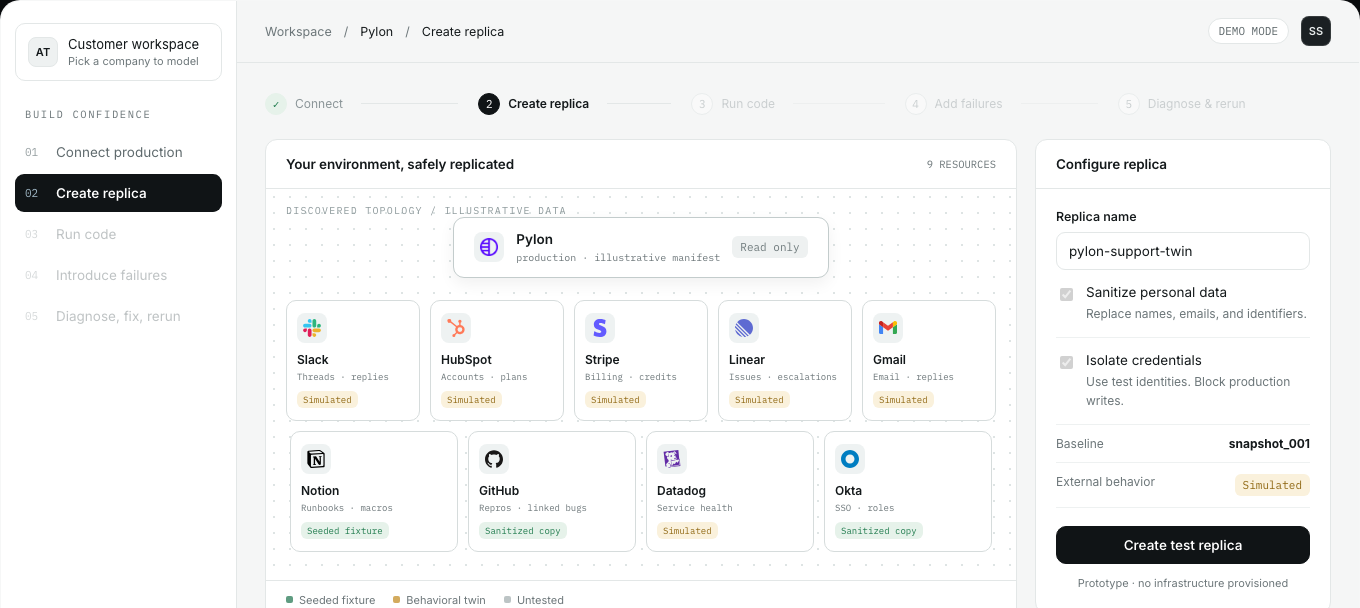
Your environment, made explicit. Map the services, state, and configuration your workflow needs.
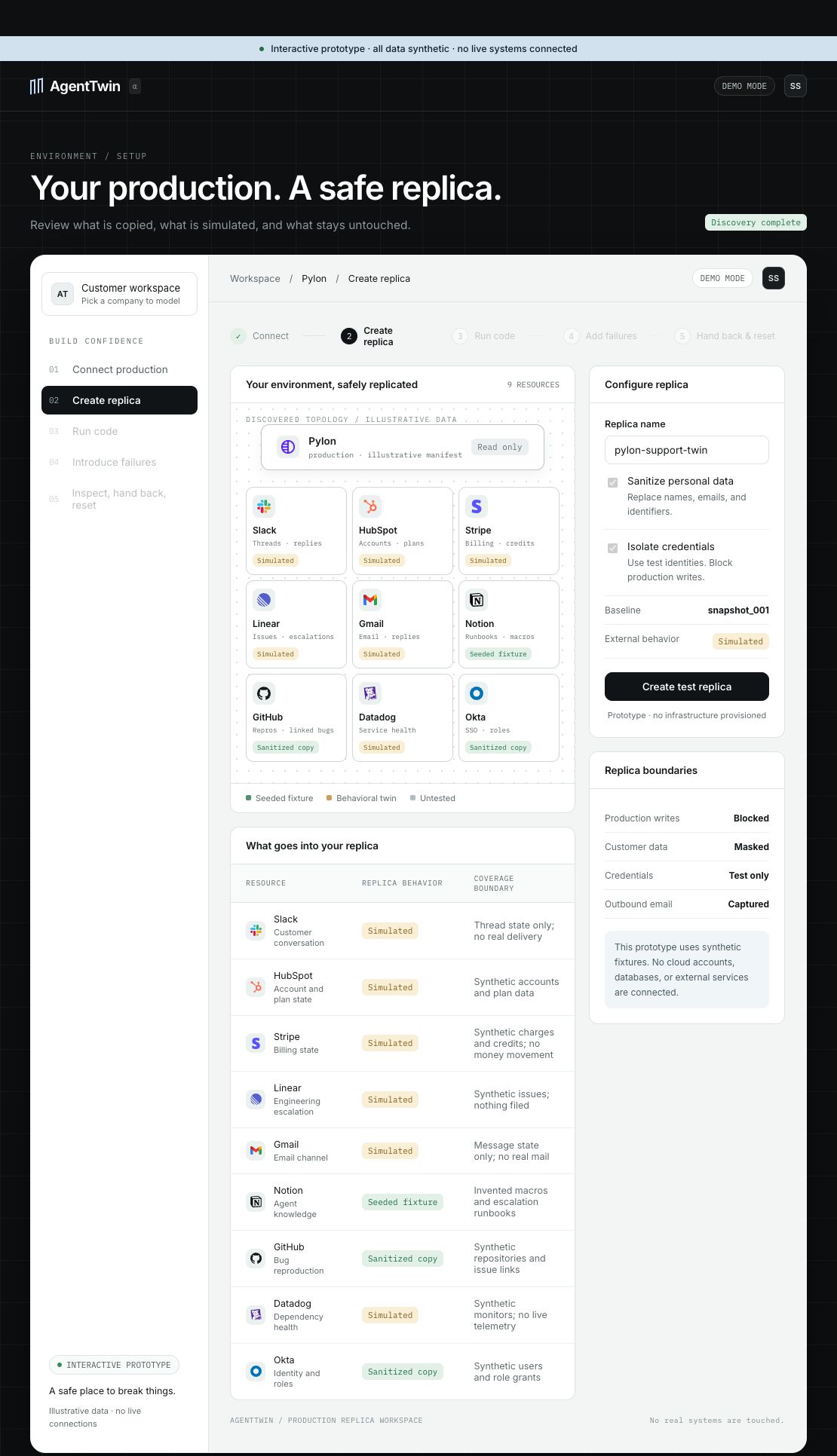
The same change. A safer world. Explore a function, release, or agent against a repeatable starting state.
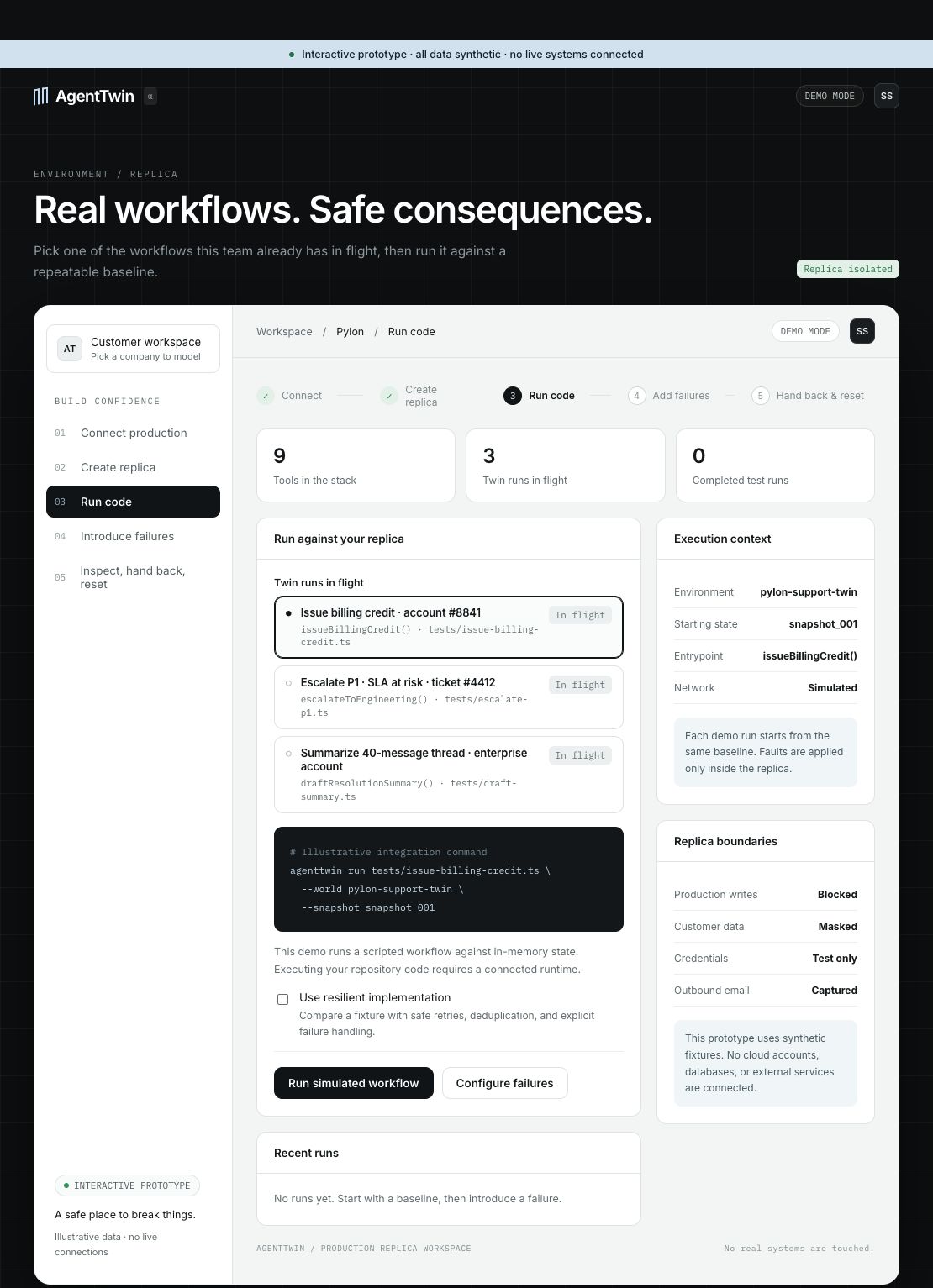
Make the edge case show up. Lose a response after a write, delay an event, or expire a permission.
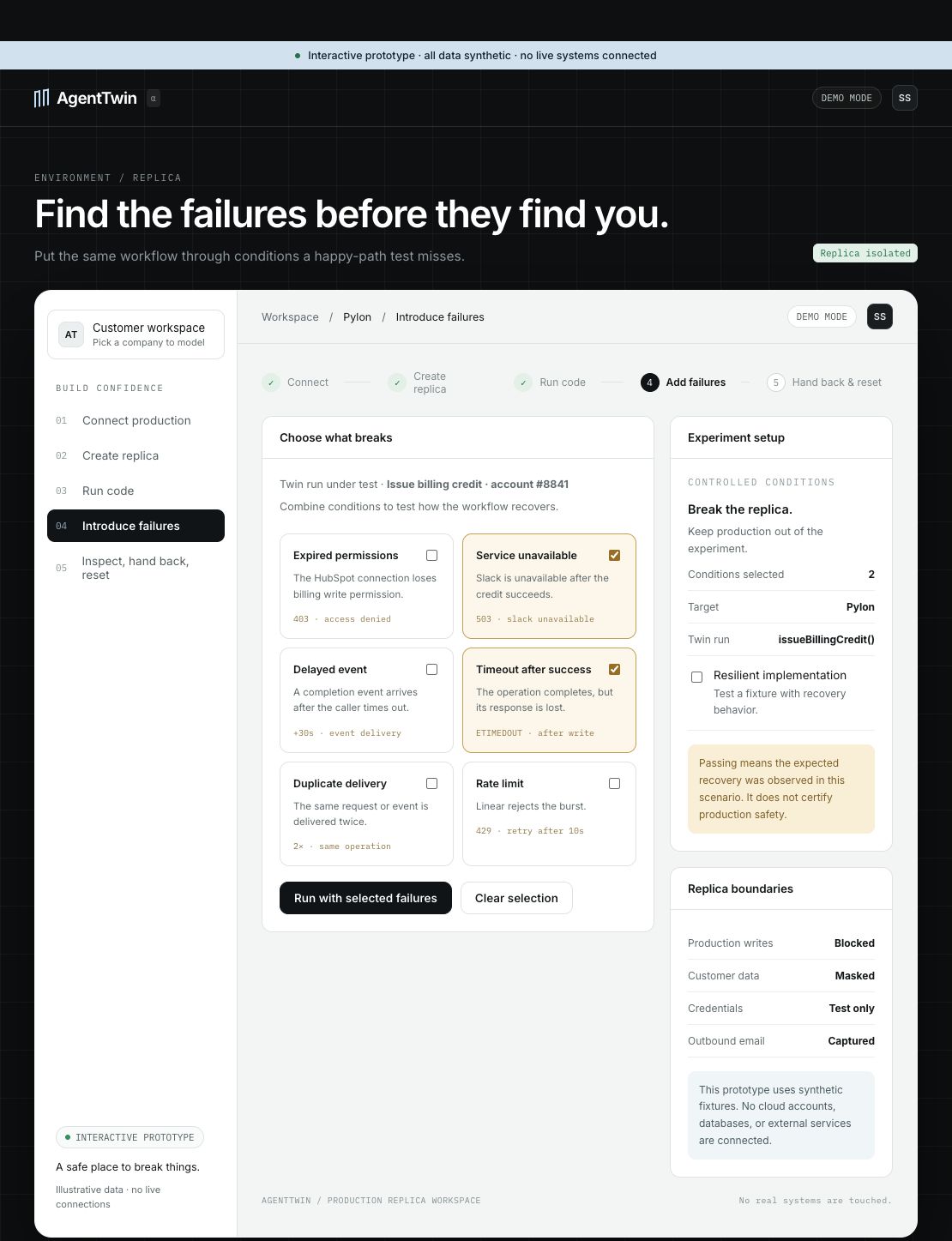
See the cause. Keep the lesson. Follow the failed assertion and state difference, then rerun the same scenario.
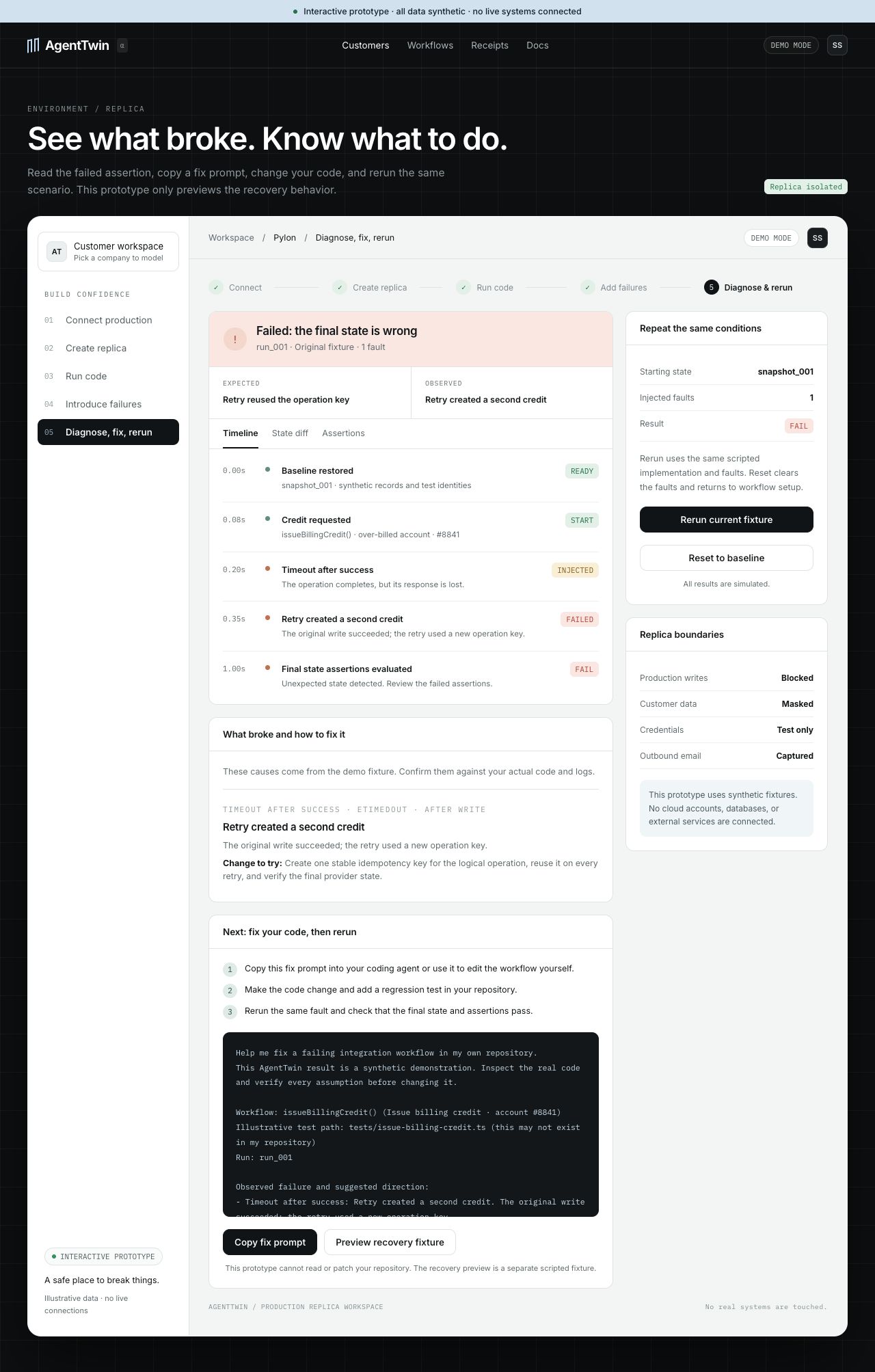
The prototype demonstrates this journey with scripted outcomes. Live discovery, provider twins, and customer-code execution are planned.

A support agent created a P1 escalation in Linear.
The alert to the on-call engineer failed to send.
No pending alert was saved, so the engineer was never notified.
Keep the created issue. Save the pending alert and retry its delivery when Slack recovers.
Rerun the outage. Verify the alert arrives after recovery and no second issue is created.
Shared context. Connected services represent one world.
Controlled failures. Exercise the condition you need.
Visible outcomes. Inspect what actually changed.
Repeatable runs. Restore the starting state.
Refund createdProvider commits the write
200Response receivedWorker records the result
OKOne refund existsExpected final state
Retries with consequences. A write can succeed even when its response never arrives.

Webhook delayedPayment state has already changed
Event delivered twiceThe same action, a second time

Permission expiredAccess changes during the run
Conditions that change. Delayed events, duplicate delivery, and permissions that expire at the wrong moment.
Read the first scenarioReplica coverageConfiguration captured
Behavior modeled
Unknowns visible
Limits made explicit. Every replica should say what is supported, verified, and still unknown.
Read the fidelity contractFailure families describe the product direction. Current outcomes are scripted; provider fidelity is not yet verified.


Potential integrations, not live connectors or customer endorsements.
Illustrative worlds

Explore a B2B support workflow with a synthetic environment.
Explore the world in the prototypeThese companies are potential customer examples, not customers or partners. Stacks, records, and incidents are invented for demonstration.

Exercise the path from a request to the database, provider, and notification. Catch partial completion across services.
A billing change that retries safely.
Inspect what an agent changed. Did it create the right record, respect the policy, and stop at the right time?
A support agent that refunds once.
Turn an incident into a repeatable scenario with the starting state, injected fault, and expected outcome.
A regression test for the next release.Proposed pricing direction.
No checkout or paid product today.
For individual exploration
For developers testing integrations
For shared testing workflows
These tiers are hypotheses, not plans for sale. Listed capabilities are planned. Read the pricing direction ↗
Questions, answered
Not yet. The prototype demonstrates the complete journey with synthetic data. Real discovery connectors, isolated execution, and provider twins are planned.
The goal is to reproduce the relevant slice of an environment for a workflow. A replica must declare its supported behavior and unknowns. It cannot guarantee that every production condition is reproduced.
Mocks can model failures, and staging can reproduce infrastructure. AgentTwin’s hypothesis is that packaging configuration, stateful service behavior, fault injection, and repeatable evidence together makes this easier to maintain. That advantage still needs validation.
The browser demo never asks for credentials or sends provider requests. The planned product uses sanitized fixtures and separate test credentials. Data handling and execution isolation must be verified before real connections are enabled.
Developers and small teams building API integrations. The first proposed implementation focuses on a Stripe write that succeeds before its response times out, so retries can be tested against the final state.